
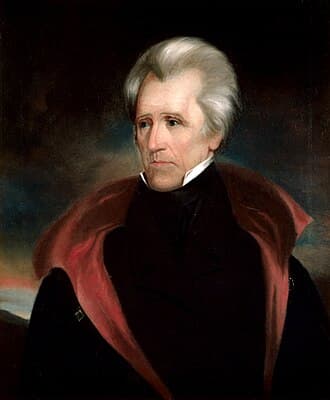
7th President of the United States
Andrew Jackson
A general who became a national figure after the Battle of New Orleans, he lost the disputed 1824 election and won a rematch in 1828. His presidency included the Indian Removal Act, which led to the forced relocation of Native American nations.
Quick facts
| President | 7th (1829–1837) |
|---|---|
| Party | Democratic |
| Born – died | 1767 – 1845 |
| Home state | Tennessee |
| Vice presidents | John C. Calhoun, Martin Van Buren |
| Elections won | 1828, 1832 |
Elections won
1828178 electoral votes to 83 (John Quincy Adams)
Andrew Jackson (Democratic) won the 1828 presidential election with 178 electoral votes to John Quincy Adams's 83. Jackson carried 15 of the 24 states that took part.
See the 1828 map1832219 electoral votes to 49 (Henry Clay)
Andrew Jackson (Democratic) won the 1832 presidential election with 219 electoral votes to Henry Clay's 49. Jackson carried 16 of the 24 states that took part.
See the 1832 mapElectoral vote counts: official Electoral College totals, via Wikipedia (CC BY-SA 4.0).
Path to the White House
- U.S. Senator from Tennessee
- Major General at the Battle of New Orleans
- Military Governor of Florida
- 7th President of the United States
Worth knowing
- The first president from the Democratic Party.
- In 1828, all but two states (Delaware and South Carolina) chose their electors by popular vote.
Common questions
- When was Andrew Jackson president?
- Andrew Jackson served as the 7th president of the United States, 1829–1837.
- What party was Andrew Jackson?
- Andrew Jackson was a member of the Democratic Party while president.
- Who was Andrew Jackson's vice president?
- John C. Calhoun, then Martin Van Buren.
- How many presidential elections did Andrew Jackson win?
- Two: 1828, 1832.