
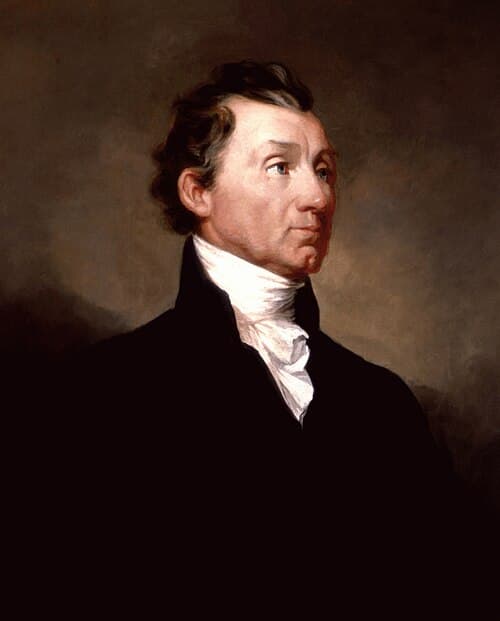
5th President of the United States
James Monroe
His presidency is known as the "Era of Good Feelings", when the Federalist Party faded and one party dominated national politics. He set out the Monroe Doctrine, warning European powers against new colonization in the Americas.
Quick facts
| President | 5th (1817–1825) |
|---|---|
| Party | Democratic-Republican |
| Born – died | 1758 – 1831 |
| Home state | Virginia |
| Vice president | Daniel D. Tompkins |
| Elections won | 1816, 1820 |
Elections won
1816183 electoral votes to 34 (Rufus King)
James Monroe (Democratic-Republican) won the 1816 presidential election with 183 electoral votes to Rufus King's 34. Monroe carried 16 of the 19 states that took part.
See the 1816 map1820228 electoral votes
James Monroe (Democratic-Republican) won the 1820 presidential election with 228 electoral votes. Monroe carried 24 of the 24 states that took part.
See the 1820 mapElectoral vote counts: official Electoral College totals, via Wikipedia (CC BY-SA 4.0).
Path to the White House
- U.S. Senator from Virginia
- Governor of Virginia
- 7th Secretary of State
- 8th Secretary of War
- 5th President of the United States
Worth knowing
- Ran essentially unopposed in 1820; one elector voted for John Quincy Adams instead.
- The third president to die on July 4 (1831).
Common questions
- When was James Monroe president?
- James Monroe served as the 5th president of the United States, 1817–1825.
- What party was James Monroe?
- James Monroe was a member of the Democratic-Republican Party while president.
- Who was James Monroe's vice president?
- Daniel D. Tompkins.
- How many presidential elections did James Monroe win?
- Two: 1816, 1820.